

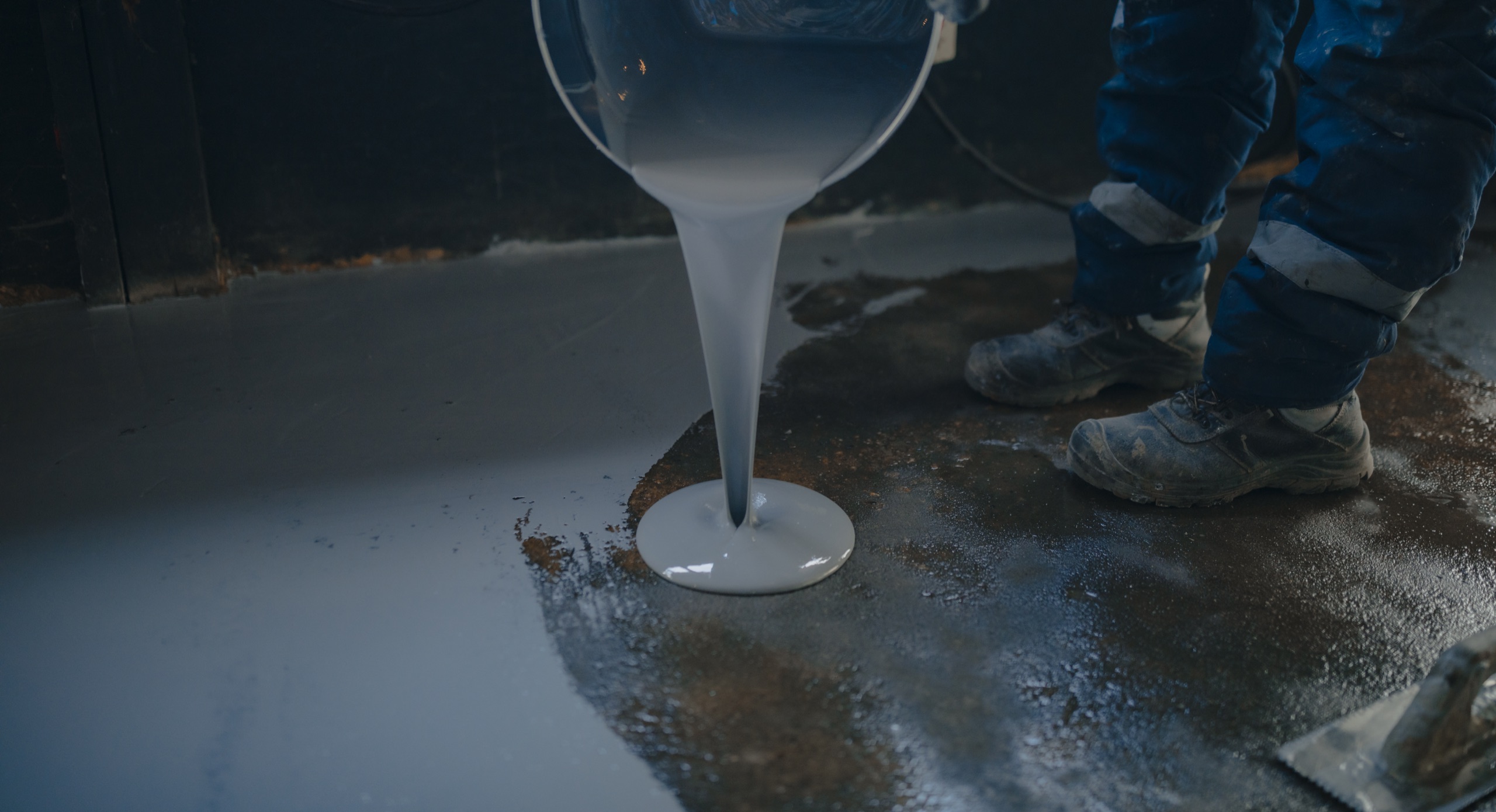
Roughly 80% of seamless-floor failures originate in the substrate, not in the topping. Adhesion failure, blistering, delamination, pinholes — almost always traceable to skipped or wrong preparation. This guide compares the six mechanical methods that modern coating manufacturers will actually warrant, with the CSP profile each produces, the machinery you will see on Israeli sites, and the constraints that quietly disqualify each option.
Why Mechanical, Not Chemical
Acid etching with diluted hydrochloric or phosphoric acid was the default for thirty years and is now deprecated by every major coating manufacturer: Sherwin-Williams Protective & Marine, Sika, MAPEI, Master Builders, BASF Construction. The reasons are not aesthetic — they are mechanical and chemical.
- Uneven profile. Etch depth depends on local porosity, age, and surface chemistry. Two square meters of the same slab can finish at CSP 1 and CSP 3.
- Residual acid. If neutralization is incomplete the acid keeps reacting in the slab for months, weakening adhesion at the 6–18 month mark — exactly when warranty claims start.
- Cannot remove contaminants. Oils, curing compounds, and previous coatings are unaffected. Etching over them locks the contamination under your new floor.
- Chloride contamination. HCl etching introduces chlorides into the slab — incompatible with 100%-solids epoxies and corrosive to rebar. On Israeli coastal projects this alone is disqualifying.
Mechanical preparation removes weak surface concrete, exposes a clean profiled substrate, and produces a measurable, repeatable CSP. The six methods below are the only universally accepted options today.
1. Shot Blasting (Open Wheel)
A centrifugal wheel throws steel shot (S110–S660 sizing) at the floor at high velocity. The shot impacts, rebounds, gets captured, separated from dust and debris in a cyclone, and recycled. The whole process runs in a closed loop with HEPA-filtered dust collection — virtually dust-free for a process that abrades concrete.
- CSP output: Small shot → CSP 3; medium shot → CSP 4–6; large shot or slow pass → CSP 7–8.
- Typical machines: Blastrac 1-8DM (8-inch path, single-phase, residential/light commercial), Blastrac 1-15D and larger (three-phase, industrial throughput up to 600 m²/shift), Diamatic, Skidabrader.
- Best for: Open floors with line-of-sight access; removing laitance, light coatings, traffic-line markings, and curing-compound residue. Required by most epoxy and polyurethane manufacturers as the default prep for industrial floors over 100 m².
- Hard limits: Cannot reach within ~50 mm of walls or columns — edges always need diamond grinding. Oil-contaminated concrete is a hard contraindication: blasting opens oil-filled pores and pulls hydrocarbons deeper, guaranteeing adhesion failure.
If you are quoting a warehouse, plant, or parking deck above 100 m², shot blasting is the only economically defensible primary method.
2. Captive (Closed-System) Shot Blasting
Shot blasting performed with an integrated vacuum/HEPA recovery package so that no abrasive or dust escapes the housing. Practically all professional shot blasting in occupied buildings, hospitals, and food plants today is captive — open-shed blasting is now confined to outdoor pavement work.
Practical consequences for an Israeli project:
- Allowable inside occupied stores, kitchens, clinics during off-hours.
- No respirable crystalline-silica release if HEPA filters are intact. PPE still required by OSHA 29 CFR §1926.1153.
- Spent shot and concrete fines accumulate in a hopper — single waste stream, easy disposal.
- Same CSP outputs as open-wheel blasting (CSP 3–8 depending on shot size).
3. Diamond Grinding
A rotating head holds diamond-impregnated segments that abrade the surface. Used for flatness, light profile, residue removal, edges, and detail work. Industry standard for the last 5–10 mm next to walls and columns, and for inside small rooms where shot blasters won't fit.
- Grit sequence: Coarse metal-bond 16/30 → 30/40 → 40/60 → 80/120 (resin) → 200 → 400 → 800 → 1500/3000 for polished concrete. For prep before coating, stop at 30/40 or 40/60 (CSP 2–3).
- Dust extraction: HEPA-filtered vacuum (M-class or H-class) is mandatory under OSHA 29 CFR §1926.1153 Table 1 for crystalline-silica control. Vacuum CFM must match shroud diameter — typically 150+ CFM for 250 mm grinders.
- Wet versus dry: Wet grinding suppresses silica but generates slurry that needs collection and pH-neutral disposal. Dry grinding is faster but demands HEPA plus N95/APF10 respirator and a written exposure-control plan.
- Residential machinery: Husqvarna PG 280, HTC 270, Lavina 25 — 250 mm planetary or single-disc grinder with vacuum.
- Commercial machinery: Husqvarna PG 820 RC, HTC 800, Lavina 30G — 500–800 mm planetary with twin 4 kW HEPA vacuum.
- CSP ceiling: Diamond grinding alone produces CSP 1–3. For CSP 4+ either change tooling to PCD (polycrystalline diamond) cup wheels or follow grinding with shot blasting.
4. Vacuum-Assisted Grinding
Identical mechanically to diamond grinding but with a sealed shroud and high-CFM HEPA vacuum locked to the grinder head. The shroud captures at least 95% of dust at source. This is the residential and retrofit default in Israel — kitchens, apartments, dental clinics, hospitals, anywhere dust escape into adjacent rooms is unacceptable. Same CSP achievable as dry grinding (CSP 1–3), same machinery, plus a high-spec vacuum and tight shroud seal.
5. Scarification (Planers)
Drum-mounted star cutters or tungsten-carbide cutters strike the surface in rapid succession, milling concrete to a controlled depth.
- Depth: Up to ~6 mm (¼ inch) per pass. Aggressive removal of thick coatings, traffic paint, mastic, rubber adhesives, or uneven slab edges.
- CSP output: CSP 4–7 depending on cutter type and pattern. Lines are linear — a corduroy texture, not random.
- Mandatory follow-up: Scarification induces micro-cracking at impact points. Most coating manufacturers require a follow-up pass with diamond grinding or shot blasting to remove the bruised layer before priming. Skipping this step is the single most common cause of coating failure on scarified floors.
- When to use: Pre-leveling before self-leveling overlays; coating removal where the coating is too thick or rubbery for grinding or shot blasting alone.
6. Scabbling (Needle Gun, Scabbler)
Pneumatic piston-driven tungsten-carbide bits hammer the surface up to 1,200 impacts per minute, fracturing concrete in small cratered patterns.
- Geometry: Used for small areas, sharp transitions, vertical surfaces, raised points, around drains, in elevator pits. Not a floor-area tool — a detail tool.
- CSP output: CSP 7–9, the most aggressive of the six. Used before thick polymer overlays (over 6 mm) that need strong mechanical key.
- Needle gun specifics: Bundle of steel rods driven pneumatically; pulverizes brittle scale, efflorescence, rust on rebar, and curing-compound crust on small or irregular surfaces.
- Drawbacks: Loud (over 105 dB), slow, severe micro-cracking — always follow with grinding or shot blasting to remove the bruised layer. Operator hand-arm vibration (HAVS) limits apply per local OH&S codes.
How to Pick the Right Method
Match the CSP you need to the coating thickness you specify. As a rule of thumb, CSP × 0.5 mm ≈ minimum coating thickness needed. Under-profiled means the mechanical key fails; over-profiled means texture telegraphs through the coating, causes pinholing, and burns excess material.
Practical decision matrix for the most common projects:
- Penetrating sealer or thin film stain (CSP 1): Fine diamond grind, no follow-up needed.
- Thin-film sealer under 0.5 mm (CSP 2–3): Diamond grind 30/40 or vacuum-assisted grind. Acceptable in residences and small commercial.
- 100%-solids epoxy 0.4–1 mm (CSP 4): Shot blast (small-medium shot) or scarification followed by grinding to remove bruised layer.
- Self-leveling epoxy 1.5–3 mm (CSP 5): Shot blast medium shot. Edges by diamond grinding.
- Polymer overlay 3–6 mm, PU-cement (CSP 6): Shot blast large shot or scarification with mandatory follow-up grind.
- Trowel-applied epoxy mortar 6 mm+ (CSP 7): Heavy shot blast or scarifier.
- Polymer overlay over 6 mm, concrete repair (CSP 8–9): Scabbler, needle gun, hydroblasting.
The CSP value is not a comfort suggestion. It is a binding spec. Every major manufacturer's warranty is conditional on matching CSP — if the contractor delivers a CSP 3 surface under a coating that demanded CSP 5, the manufacturer's defense to a delamination claim is automatic.
Verification — Before You Coat
Compare the prepared surface against ICRI replica chips under raking light immediately after prep, before the surface is contaminated by foot traffic or settling dust. Document with photographs alongside the chip per ICRI 310.2R Appendix. On warranty-critical projects (food plants, healthcare, pharma) this photographic record is the only evidence that prep was correct — keep it for the full warranty term.
Read next: ICRI CSP 1–10: which profile for which coating · Moisture testing: ASTM F2170, F1869, calcium chloride, Tramex · Pull-off testing per ASTM D7234 and EN 1542.
Sources
- ICRI Technical Guideline 310.2R-2013 — Selecting and Specifying Concrete Surface Preparation for Sealers, Coatings, Polymer Overlays, and Concrete Repairs.
- Shot Blast Inc. — Shot Blast Preparation Guide (2015).
- Polycote — Captive Shot Blasting and Vacuum-Assisted Shot Blasting documentation.
- Sherwin-Williams Protective & Marine — Acid Etching Is No Longer Recommended (technical bulletin).
- OSHA 29 CFR §1926.1153 — Occupational Exposure to Respirable Crystalline Silica.
- TCC Materials — Concrete Surface Preparation and Profiles chart.
- DeFelsko — CSP Chips reference set.