Before choosing a brand (Sika vs Mapei vs Master Builders), choose the resin family. Three families dominate industrial resin flooring in 2026: epoxy self-levelling, PU-cement (polyurethane modified concrete), and MMA (methyl methacrylate fast-cure). Each owns a different parameter envelope. Specifying the wrong family at this level — independent of brand — produces failure regardless of which brand you pick. This article compares the three at the system level, before brand selection narrows the field further.
What each family actually is
Epoxy SL (Self-Levelling)
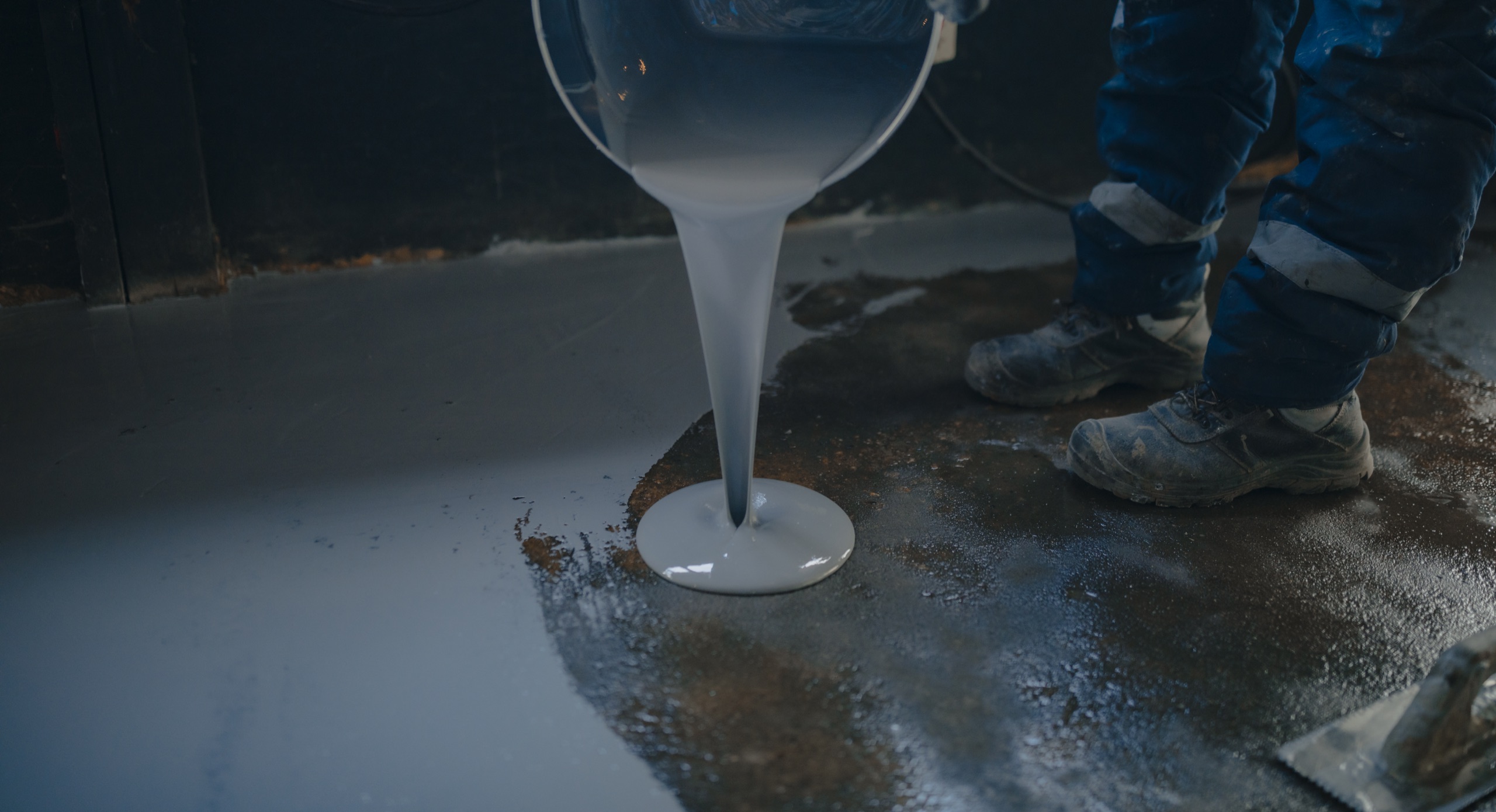
Two-component epoxy resin (bisphenol-A epoxy + amine hardener), filled with quartz aggregate or pigment, poured at 2–3 mm and self-levels to a smooth finish. Cures by chemical reaction in 24–48 hours to walking traffic, 7 days to full chemical resistance. The reference product is Sikafloor-263 SL. FeRFA Type 5 classification. Service life 8–15 years.
PU-Cement (Polyurethane-Modified Concrete)
Three-component system: polyol resin + isocyanate + cementitious filler. Trowelled at 4–9 mm, cures in 24–48 hours to traffic, 7 days to full chemical and thermal resistance. The reference products are Sikafloor PurCem HM-20, Ucrete UD200, Flowfresh HF. FeRFA Type 6–8 classification. Service life 15–25 years.
MMA (Methyl Methacrylate)
Two-component acrylic resin + peroxide initiator. Cures in 1–2 hours to walking traffic — the fastest cure in industrial flooring. Trowelled at 3–6 mm in a single application. Reference products: Sikafloor-403 / 404, MasterTop 1817PC, Mapefloor Reaction Plus. FeRFA Type 3–5 classification. Service life 10–20 years. Strong odour during install — ventilation critical.
Side-by-side parameter table
| Parameter | Epoxy SL | PU-Cement | MMA |
|---|---|---|---|
| Typical thickness | 2–3 mm | 4–9 mm | 3–6 mm |
| Cure to foot traffic | 24–48 h | 12–24 h | 1–2 h |
| Cure to full chemical | 7 d | 7 d | 24 h |
| Compressive strength | ~75 N/mm² | ~55–58 N/mm² | ~80 N/mm² |
| Tensile strength | ~25 N/mm² | ~10–15 N/mm² (flexible) | ~20 N/mm² |
| Thermal range continuous | 15–60°C | –40°C to 120°C | –30°C to 80°C |
| Thermal range peak | ~70°C briefly | 200°C (Ucrete) | ~100°C briefly |
| Chemical resistance | Good (lab, food) | Excellent (aggressive) | Good |
| Slip class with broadcast | R10–R12 | R11–R13 | R11–R13 |
| Decorative range | Wide (RAL + multicolour) | Limited (6–10 tones) | Limited (~12 tones) |
| HACCP / food-safe | Yes | Yes (heavy industry) | Yes |
| Cost (₪/m² installed) [verify] | ₪220–₪380 | ₪380–₪620 | ₪380–₪650 |
| Install odour | Mild | Mild to moderate | Strong (ventilation critical) |
| UV stability | Aromatic — yellows; aliphatic — stable | Mostly UV-stable | UV-stable |
| FeRFA Type | Type 5 | Type 6–8 | Type 3–5 |
Where each family wins
Epoxy SL wins when…
- The budget caps the line item. Epoxy SL is the cheapest of the three at parity spec — ~40–50% of PU-cement, ~60% of MMA. For mid-spec industrial work where ambient temperature and moderate chemical exposure are the demands, epoxy SL closes the spec.
- Decorative range matters. Epoxy SL has the widest colour palette across the three. Multicolour blends, decorative aggregate broadcast, and RAL custom matching all work easily.
- The floor must look "clean" and modern. Epoxy SL's glossy self-levelled finish reads as the industrial-modern aesthetic. Polished concrete substitute, retail backstage, light commercial — all default to epoxy SL.
PU-cement wins when…
- Thermal cycling is daily. Steam wash-down, hot-vessel proximity, cold-store transitions. Epoxy cracks under thermal cycling; PU-cement absorbs it.
- Chemical exposure is aggressive. Food production with daily fat and acid, brewery wash-down, dairy, pharmaceutical. PU-cement's chemical resistance is the industry reference at this exposure level.
- Service life beyond 15 years is required. Stadium kitchen, university dining hall, food production line where re-laying the floor every 8 years is intolerable. PU-cement's 15–25 year service life justifies the line-item premium.
- The slab will move thermally. Coast-line construction, refrigeration plant, hot-press machinery. PU-cement's flexibility under thermal expansion is the differentiator.
MMA wins when…
- Production downtime is the dominant cost. A factory shutdown costs ₪20,000 per hour. The 1–2 hour MMA cure vs 24-hour competitor cure pays for itself many times over.
- Cold-temperature install is required. MMA cures down to –5°C. Cold-store fit-out, winter retrofit, outdoor exposed install — MMA is the only family that works.
- Outdoor UV exposure is constant. MMA is naturally UV-stable; epoxy needs an aliphatic PU topcoat for UV stability; PU-cement is mostly UV-stable but not engineered for it.
- Crack-bridging is critical. MMA bonds to almost any substrate with minimal preparation and bridges existing cracks better than epoxy SL.
Where each family loses
Epoxy SL fails when…
- The floor sees thermal cycling above 60°C continuous or 70°C peak. Epoxy softens and cracks.
- The chemical exposure is aggressive (concentrated acids, strong solvents, hot caustic). PU-cement or specialty chemical-resistant systems (Stonchem novolac) own this.
- Production downtime cost dominates the decision. 24-hour foot-traffic cure is too slow.
- The substrate has elevated moisture (RH > 75% per ASTM F2170). Epoxy bonds poorly above this threshold; PU-cement tolerates up to ~85% RH.
PU-cement fails when…
- The project is dry, ambient, mid-spec. PU-cement is over-engineered and over-priced for this envelope.
- The decorative range is the priority. PU-cement's 6–10 tone palette does not match epoxy SL's flexibility.
- The thickness build-up (4–9 mm) is incompatible with substrate level or door clearances. Epoxy SL at 2–3 mm fits where PU-cement does not.
MMA fails when…
- The site cannot tolerate the install odour. MMA's strong methacrylate smell makes occupied-building retrofit (offices, hotels, residential) impractical even with ventilation.
- The budget cap pushes toward epoxy SL parity. MMA's faster cure pays back only when downtime cost is high.
- Aggressive thermal extreme is present. MMA's –30 to 80°C envelope is narrower than PU-cement.
The selection sequence
- Map thermal envelope. Above 80°C continuous or above 120°C peak → PU-cement is the only credible family.
- Map shutdown cost. Above ₪10,000/hour → MMA pays for itself; otherwise epoxy SL or PU-cement.
- Map chemical exposure. Daily aggressive chemicals → PU-cement. Moderate exposure → epoxy SL or MMA.
- Map decorative priority. Wide colour palette + decorative aggregate → epoxy SL. Functional industrial → any family.
- Map budget. Hard cost cap → epoxy SL. Premium-spec acceptance → PU-cement or MMA.
- Map substrate moisture. Above 75% RH → PU-cement preferred over epoxy SL.
- Now pick the brand. Within the chosen family, refer to Sika vs Mapei vs Master Builders or the PU-cement-specific PU-cement Big-3 comparison.
Common spec mistakes the families catch
- Specifying epoxy SL for a commercial kitchen. Daily steam wash-down kills epoxy. Should be PU-cement (Flowfresh HF / Sikafloor PurCem). Saves the warranty claim 18 months in.
- Specifying PU-cement for an office reception. Over-engineered. Epoxy SL at 2–3 mm closes the spec for half the cost.
- Specifying MMA for an occupied building retrofit. Odour drives tenants out. Should be epoxy SL or PU-cement with ventilation planning.
- Specifying epoxy SL on a substrate with ASTM F2170 at 80% RH. Will delaminate. Should be PU-cement which tolerates higher moisture.
Final read
The resin family is the system-level decision before brand selection. Epoxy SL for mid-spec, decorative-priority, ambient-temperature work. PU-cement for thermal extreme, heavy chemical exposure, long service life. MMA for fastest cure, cold install, occupied building with proper ventilation. Pick the family before the brand; otherwise brand selection is meaningless.
Related: PU-cement Big-3 comparison · Sika vs Mapei vs Master Builders · Epoxy SL system page · PU-cement system page.
Sources
- FeRFA Type 1–8 classification standards (UK Resin Flooring Association).
- EN 13813 SR (synthetic resin) binder classification.
- Sika Flooring portal
- Master Builders Solutions
- Mapei Mapefloor resin lines